
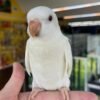
Looking for a white Quaker parrot for sale? You are in the right place. We hand-raise stunning white Quaker parrots, including true albino and rare white mutations, and we keep birds in every age group. Whether you want a cuddly hand-fed baby, a young bird ready to bond, or a talking adult, you can find your perfect companion here.
White Quakers are one of the most eye-catching color mutations of the Monk Parakeet (Myiopsitta monachus). They carry the same smart, playful, and affectionate personality that made Quakers famous, wrapped in a soft white coat that turns heads. Every bird we sell is hand-fed, socialized, and health-checked before it goes home.
You can reserve your quaker parrot online in minutes, and we ship safely to homes across the United States where ownership is legal. Prices for white Quakers usually run higher than the common green, and we break down the full price range below so you know exactly what to expect.
What Is a White Quaker Parrot?
A white Quaker parrot is a color mutation of the standard green Quaker. The wild Quaker is bright green with a gray chest. Through years of selective breeding, aviculturists have produced a rainbow of colors, and the white varieties are among the rarest and most prized.
Here is the part most sellers skip. “White Quaker” is not one single bird. It is a small family of mutations that all look mostly white. Knowing the difference helps you pick the right bird and understand the price you pay.
Albino Quaker Parrot (True White)
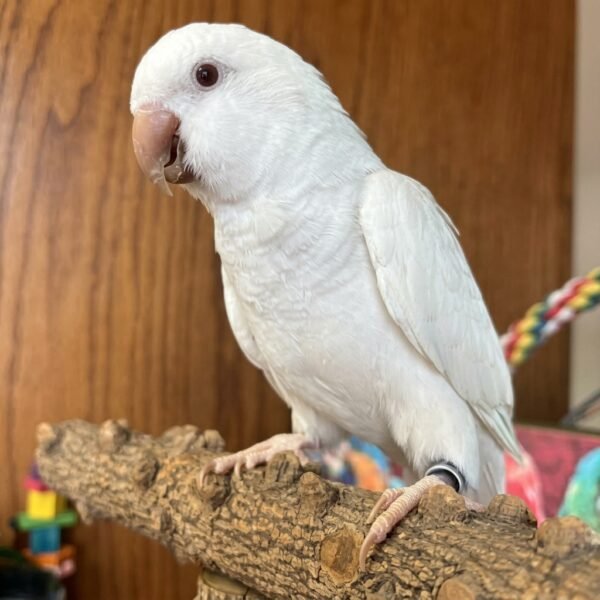
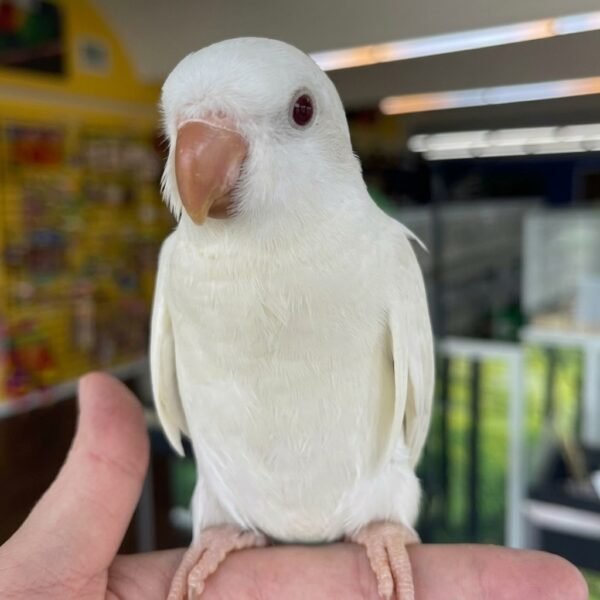
The albino Quaker is the purest white bird of the group. It is solid white from head to tail with no other color. Albinos have red or pink eyes and a pinkish-orange beak and feet. This look comes from the ino gene paired with the blue series, which removes all pigment. True albinos are hard to breed, which is why the albino Quaker parrot price sits at the top of the range.
Lutino Quaker Parrot (Pale Yellow-White)
The lutino Quaker is often sold under the “white” label, but it is really a pale yellow bird. It has soft yellow plumage with a grayish-white forehead and underparts, plus red eyes. In certain light it can look almost white. Lutinos are one of the most uncommon Quaker mutations, so they also carry a premium price.
Blue Crossover and White Platinum Quakers
Some white Quakers are crossover or platinum birds. A blue crossover is mostly white with a soft powder-blue tail. The white platinum Quaker is a near-white bird with a faint pastel wash. These birds give you the clean white look with just a hint of color, and they are very popular with buyers who want something one of a kind.
| Mutation | Appearance | Eye Color | Rarity | Typical Price (USD) |
| Albino | Solid pure white | Red / pink | Very rare | $600 to $1,200 |
| Lutino | Pale yellow, near white | Red | Very rare | $500 to $900 |
| Blue crossover | White with powder-blue tail | Dark | Rare | $450 to $800 |
| White platinum | Near-white pastel | Dark | Rare | $900 to $1,200+ |
Prices vary by age, breeder, and region. Rare adults and show-quality birds sit at the top.
No matter which white type you choose, the bird’s brains and charm are exactly the same. The color changes the feathers, not the personality.
White Quaker Parrots for Sale in Every Age
We keep white Quakers at every life stage, so you can choose the age that fits your home and your experience. Age matters a lot with parrots. It shapes taming, talking, feeding, and how quickly the bird bonds with you.
Hand-Fed Baby Quakers (About 6 to 8 Weeks)
Our youngest babies are still being hand-fed by our team. At this stage they need formula feedings a few times a day. For their safety, we do not send unweaned babies to first-time owners. If you have hand-feeding experience and want to raise a bird from the very start, we will guide you through it. Reserve early, since baby white Quakers sell fast.
Weaned Juveniles (About 8 to 12 Weeks)
This is the most popular choice, and the one we recommend for most families. A weaned juvenile eats on its own and is still young enough to bond deeply with a new owner. These birds are gentle, curious, and eager to learn. They love sitting on your shoulder, cuddling, and starting their first words in the months ahead.
Young Quakers (Under 1 Year)
Young birds are past the baby stage but still very open to training. They already have full feathers and a settled diet. Many are beginning to talk or whistle. A young Quaker is a great pick if you want a bird that is a little more independent yet still easy to shape.
Adult White Quakers (1 Year and Older)
Our adult white Quakers are fully grown, each with a clear personality. Some already talk, so you can hear them before you decide. Adults suit buyers who want to know exactly what they are getting. With a lifespan of 20 to 30 years, an adult Quaker still has decades of companionship to give.
Not sure which age is right? Tell us about your home and experience, and we will match you with the best white Quaker for you. Every bird, at every age, is hand-raised and socialized before it ships.
White Quaker Parrot Price: What to Expect
White Quakers cost more than the common green Quaker. That is simple supply and demand. Green Quakers are widely bred and often sell for $75 to $150. White and albino birds are far less common, so they carry a higher price.
Here is a general price guide for the USA market:
- Green (normal): $75 to $150
- Blue: $200 to $500
- Blue crossover (white with blue tail): $450 to $800
- Lutino (yellow-white): $500 to $900
- Albino (pure white): $600 to $1,200
- White platinum: $900 to $1,200 and up
Several things move the price up or down: the exact mutation, the bird’s age, whether it is DNA sexed, and your location. Rare adults and show-quality birds sit at the top of the range.
Every white Quaker from us includes a health guarantee, a leg band for identification, and full feeding and care notes. We believe a fair white Quaker parrot price should include a healthy, well-socialized bird and real support after your purchase, not just the animal.
Are White Quakers Good Pets? Talking and Personality
Yes. Quaker parrots are one of the best pet birds for families, singles, and first-time owners. People call them the clowns of the parrot world because they are so playful and full of character. The white mutation has the exact same friendly nature as the green.
Talking ability. This is a big reason people choose Quakers. Pound for pound, Quakers are the best talkers among the small parrots. Many start talking around 6 months of age, and some pick up words even earlier. With daily attention, a Quaker’s vocabulary can rival that of a much larger African Grey. They also whistle tunes and copy everyday household sounds.
Do white and albino Quakers talk as well as green ones? Yes. The color gene only changes the feathers. It has no effect on the brain, so a white Quaker learns to talk just as well as any other Quaker.
Personality. Quakers bond closely, often to one person or a whole family. Fans call them velcro birds because they love to stay near you. They are confident, curious, and a little bossy in the best way. Give them toys, time, and training, and they thrive.
Noise. Quakers are not the loudest parrots, but they do chatter and have an alarm call like all parrots. They fit most homes, though a very thin-walled apartment may need a plan for their busy moments.
Quaker Parrot Facts and Quick Care Guide
Before you bring home a white Quaker, it helps to know the basics. Quakers are hardy and easy to care for, which is another reason they are so popular.
| Feature | Detail |
| Scientific name | Myiopsitta monachus |
| Other names | Monk Parakeet, Quaker Parakeet |
| Origin | South America |
| Length | 11 to 12 inches |
| Weight | 90 to 150 grams (about 110 to 120 on average) |
| Lifespan | 20 to 30 years, often longer with good care |
| Talking | Excellent for a small parrot |
| Legal status | Restricted in some US states (see below) |
Diet
A healthy Quaker eats a pellet-based diet. Pellets should make up about 60 to 70 percent of meals. Add fresh vegetables every day and a small amount of fruit. Avoid an all-seed diet. Too much seed leads to weight gain and fatty liver disease. Fresh, clean water should always be available.
Cage and Environment
Quakers are smart and love to chew, so give them a roomy cage with bar spacing of about five-eighths of an inch. They are famous escape artists that can pick simple locks, so a secure latch matters. Add natural wood perches and plenty of toys. Fun fact: the Quaker is the only parrot that builds free-standing stick nests, and in the wild these nests can house a whole colony.
Lifespan
With good food, a clean home, and regular checkups from an avian vet, a Quaker can live 20 to 30 years. Many live even longer. This is a long-term commitment, so plan for a friend that may be with you for decades.
Is It Legal to Own a Quaker Parrot in Your State?
This is the most important thing to check before you buy, and most sellers gloss over it. Because Quakers can form wild colonies, some US states restrict or ban them. We only ship to states where ownership is legal.
States that ban or heavily restrict private ownership commonly include California, Colorado (with an exception for birds owned before 1990), Connecticut, Georgia, Hawaii, Kansas, Kentucky, Maine, Pennsylvania, Rhode Island, Tennessee, and Wyoming.
States that allow ownership with rules such as permits, banding, or wing clipping can include New Jersey, New York, Ohio, and Virginia. For example, New York requires birds to be identified with a leg band.
Laws change, and some rules vary by county or city. This list is a starting point, not legal advice. Always confirm the current rules with your state wildlife agency before you order. The Quaker Parakeet Society is a helpful place to begin your research. If your state allows Quakers, we will get your new bird to you safely.
Are White and Albino Quakers Healthy?
A common worry is that white or albino birds are weaker than green ones. Here is the honest answer. A white Quaker raised by a good breeder is just as healthy as any other Quaker.
Albino birds have red eyes because they lack dark pigment. This can make them a little more sensitive to very bright light, so simply keep the cage out of harsh direct sun. That is the only real difference in daily care.
The bigger factor for any Quaker is proper screening. Responsible breeders test for common avian diseases such as polyomavirus and PBFD before selling. Every bird we offer is raised in clean housing, fed a balanced diet, and health-checked so it arrives strong and ready for its new home.
How We Raise and Ship Our White Quakers
Buying a bird is about trust. Here is how we care for every white Quaker before it becomes part of your family.
Our birds are hand-fed from a young age and handled daily, so they are tame and used to people. We wean each bird onto a quality pellet and fresh food diet. Because male and female Quakers look identical, we offer DNA sexing on request. Each bird gets a health check and a leg band for identification.
When it is time to travel, we use safe, climate-aware shipping with clear tracking, and we back every order with a live arrival guarantee. From your first click to the day your bird lands, our goal is a smooth, honest experience. That is what buying a quaker parrot online should feel like.
How to Buy a White Quaker Parrot Online
Getting your new bird is simple:
- Pick your bird. Choose the white mutation and age that fits you.
- Check your state. Make sure Quakers are legal where you live.
- Reserve it. Place a deposit to hold your bird, especially for babies.
- Arrange shipping. We set up safe delivery to your door.
- Welcome your Quaker. Get feeding and care support from day one.
Have questions before you buy? Reach out and we will help you choose. Browsing white Quaker parrots for sale should be exciting, not confusing, and we are here to make it easy.
Frequently Asked Questions
How much is a white Quaker parrot?
Most white Quakers sell for $500 to $1,200 in the USA. Pure albino and platinum birds sit at the top of that range. The exact price depends on the mutation, the bird’s age, and whether it is DNA sexed. Rare adults cost more than common babies.
Do white and albino Quaker parrots talk?
Yes. White and albino Quakers talk just as well as green Quakers. The color gene changes only the feathers, not the brain. Most Quakers start talking around 6 months old and can learn a large vocabulary with daily practice.
What is the rarest Quaker parrot color?
The pure albino and lutino mutations are among the rarest. Both are hard to breed, which is why they cost more than blue or green Quakers. White platinum birds are also uncommon and highly sought after.
Are Quaker parrots legal in my state?
It depends. Quakers are banned or restricted in about a dozen states, including California, Georgia, and Hawaii. Others allow them with a permit or leg band. Always confirm your local rules before you buy. We only ship where ownership is legal.
What age Quaker parrot is best to buy?
For most first-time owners, a weaned juvenile of 8 to 12 weeks is the best choice. It eats on its own and bonds quickly. If you want a known personality or a bird that already talks, an adult may suit you better. We offer every age.
Do you ship white Quaker parrots nationwide?
We ship to homes across the United States where Quakers are legal to own. Every bird travels with safe, tracked shipping and a live arrival guarantee. We confirm delivery details with you before your bird ships.
Is a male or female white Quaker better?
Both make great pets. Male and female Quakers look the same and have similar personalities, so neither one is a better pet. Since they are identical on the outside, we offer DNA sexing if you want to know for sure.
How long do white Quaker parrots live?
A white Quaker can live 20 to 30 years, and often longer with good care. That includes a balanced diet, a clean cage, mental stimulation, and regular visits to an avian vet. With that kind of care, a white Quaker is a true long-term companion.
Bring Home Your White Quaker Parrot Today
A white Quaker parrot gives you the best of both worlds: a rare, beautiful bird and a smart, loving companion that can talk, play, and bond for decades. With hand-fed birds in every age and a health guarantee on each one, finding the right white Quaker parrot for sale has never been easier.
Ready to meet your new friend? Browse our current white Quakers, pick the age and mutation you love, and reserve your quaker parrot online today. Your feathered companion is waiting.


Reviews
There are no reviews yet.