
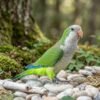
Looking for a healthy, hand-raised green quaker parrot for sale? You’re in the right place. At QuakerParrot.online, we raise friendly, well-socialized green quakers and match each bird with the right home. Whether you want a hand-fed baby, a weaned juvenile, or a tame adult, we keep green quaker parrots of every age ready to go.
The green quaker, also called the monk parakeet (Myiopsitta monachus), is one of the most popular pet parrots in the United States. It’s small, smart, playful, and a surprisingly strong talker for its size. Our green quaker parrots online are raised by hand, fed a healthy diet, and cared for until they’re ready to bond with you.
Below you’ll find current pricing, the ages we have available, care basics, talking ability, and an honest guide to the one thing many sellers skip: whether it’s legal to own a quaker parrot in your state.
What Is a Green Quaker Parrot?
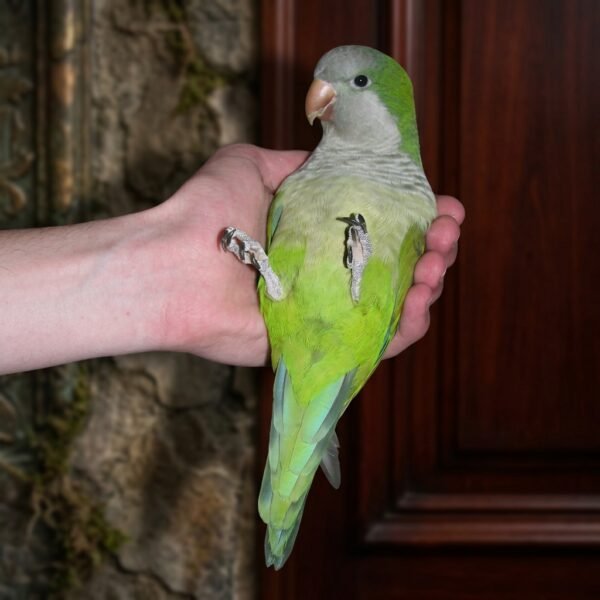
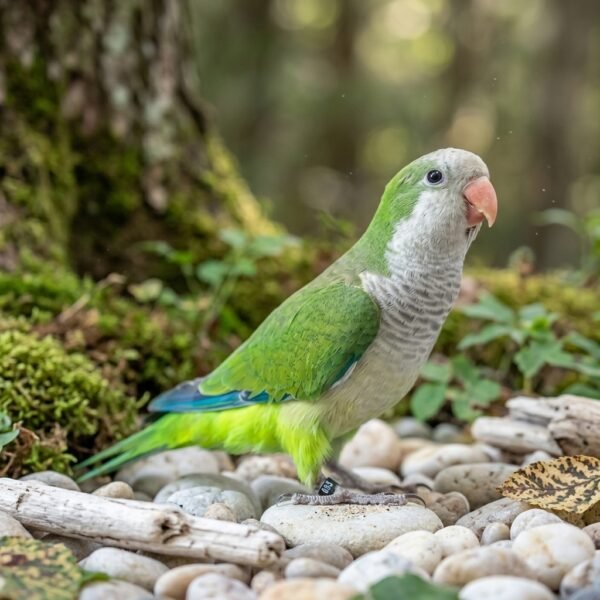
The green quaker parrot is the original, natural color of the species. In the wild, every quaker is green, the blue, white, cinnamon, and other colors you see for sale are captive-bred color mutations. That makes the green quaker the classic look: bright green wings and back, a soft gray chest and cheeks (the reason it’s called the “quaker” or “monk”), and a pale, greenish-yellow belly. The beak is a pinkish horn color.
Quakers are native to the temperate and subtropical regions of South America, including parts of Argentina, Bolivia, Brazil, and Paraguay. They belong to the true parrot family, Psittacidae. Here’s what to expect from a green quaker at a glance:
- Size: about 11 to 13 inches (28–33 cm) from head to tail
- Weight: roughly 90 to 120 grams; males often weigh slightly more than females
- Wingspan: around 19 inches (48 cm)
- Lifespan: commonly 15 to 20 years with good care, and some live 25–30 years
- Talking: yes, quakers are among the best small talking parrots
One fact sets quakers apart: they are the only parrot species that builds large, communal stick nests. That same adaptability is why escaped pets have formed wild colonies, research from the University of Chicago found naturalized parrot populations (including monk parakeets) across 23 U.S. states. It’s also the reason for the state laws we cover further down.
Green Quaker Parrots for Sale: Every Age Available
Age matters when you’re choosing a parrot. A younger bird bonds and learns to talk quickly, while an older bird may already be tame and settled. We keep green quaker parrots of every age, so you can pick the stage that fits your experience and lifestyle.
Hand-Feeding Baby Green Quakers (under ~8 weeks)
These are our youngest babies, still being spoon- or syringe-fed formula. We generally recommend babies at this stage only for experienced keepers, because hand-feeding mistakes can harm a chick. In most cases, we let our babies fully wean before they go home. (Some states, like California, legally require birds to be weaned before sale.) If you want to be part of the early bonding, you can reserve a baby now and bring it home once it’s weaned.
Weaned Baby Green Quakers (about 8–12 weeks) – Most Popular
This is the sweet spot for most families. By 8 to 12 weeks, a green quaker is eating on its own, fully feathered, and at the perfect age to bond with a new owner. Hand-fed, weaned babies are gentle, curious, and quick to learn words and tricks. If you want a bird that grows up trusting you, start here.
Juvenile & Young Green Quakers (3–12 months)
Young quakers are past the baby stage but still very adaptable. They’re playful, active, and still learning to talk. This age is great if you want a slightly more independent bird that’s still young enough to bond closely.
Adult Green Quakers (1 year and older)
Adult green quakers are a smart choice if you’d rather skip the baby stage. Many of our adults are already tame and used to people, and some already say a few words. Adults are also a good option for busy owners, since they’re past the most demanding early months.
Bonded Pairs & Breeders
We also offer bonded and proven pairs for hobbyists who want to set up an aviary or start breeding. Pairs are usually sold as companions for each other rather than as hands-on pets. DNA sexing is available so you know exactly what you’re getting.
| Age | Best For | Talking & Bonding | Notes |
| Hand-feeding baby (under 8 wks) | Experienced keepers | Strongest bonding potential | Usually reserved; sent home after weaning |
| Weaned baby (8–12 wks) | First-time & family owners | Bonds fast; learns to talk early | Our most popular choice |
| Juvenile / young (3–12 mo) | Owners wanting a young, playful bird | Still learns quickly | Good balance of youth and independence |
| Adult (1 yr+) | Busy owners; skip the baby stage | May already talk; still trainable | Often already tame |
| Bonded / proven pair | Aviaries & breeders | Bond to each other | DNA sexing available |
Does age affect talking? Younger birds usually pick up words fastest, but don’t count out an adult — with patience and daily practice, older green quakers can still learn to talk and bond closely.
How Much Does a Green Quaker Parrot Cost?
Green quakers are usually the most affordable color, because green is the natural, most common coloration. Prices vary by age, tameness, region, whether the bird is DNA-sexed, and whether it ships. As a general guide across U.S. breeders and stores:
- Green (normal) quaker: roughly $250–$500 for a hand-fed pet bird
- Breeder-direct greens: can start lower, around $75–$150 in some local markets
- Color mutations cost more: blue around $400–$600, and rarer colors like albino, lutino, or opaline can run $500–$800+
What raises the price of a green quaker?
- Age and tameness: hand-fed, well-socialized babies cost more than parent-raised birds
- DNA sexing: knowing the sex adds value, especially for breeders
- Shipping: live-animal air travel and a carrier add cost
- Extras: a starter cage, food, or a health check
| Color / Type | Typical Price Range | Notes |
| Normal Green (hand-fed pet) | $250 – $500 | Best value; the classic color |
| Green Pallid / Pastel | $350 – $550 | Lighter green mutation |
| Green Opaline | $400 – $550 | Patterned green mutation |
| Blue Quaker | $400 – $600 | Popular mutation |
| Albino / Lutino (white / yellow) | $500 – $800+ | Rarer, priciest |
Prices are approximate and vary by season and availability. Contact us for current green quaker parrot pricing.
Can Green Quaker Parrots Talk?
Yes — and they’re good at it. Green quaker parrots are considered one of the best talking birds for their small size. Many learn a solid range of words and short phrases, and some build vocabularies of dozens of words with regular practice. Color doesn’t change talking ability — a green quaker talks just as well as a blue or white one.
Quakers usually start attempting their first words between 6 months and a year old, though every bird is different. A few tips that help:
- Repeat the same words clearly, every day
- Start with short, upbeat words like “hello” or “pretty bird”
- Talk during bonding time, such as morning greetings
- Be patient and consistent, reward attempts with attention
Are males or females better talkers? Both sexes can talk well. There’s no strong, proven difference, personality and training matter far more than sex. Because male and female quakers look alike, DNA testing is the reliable way to know which you have.
Green Quaker Parrot Personality & Temperament
Green quakers are big personalities in a small package. They’re playful, bold, affectionate, and often described as clownish. They bond strongly with their owners and love to be part of daily life.
They also have a feisty streak. Quakers can be territorial about their cage, so early handling and consistent, gentle training help a lot. A well-socialized green quaker is confident, funny, and deeply attached to its favorite person.
Because they’re so social, quakers need real attention every day. A bored, ignored quaker can become nippy or noisy. Give it time, toys, and interaction, and you’ll have a loyal companion for years.
Green Quaker Parrot Care Basics
Green quakers are hardy and fairly easy to care for, but they do need the right setup.
Cage & Space
Give your quaker the biggest cage you can. Around 18 x 18 x 18 inches is a common starting point, but bigger is always better, with bar spacing near 1/2 to 5/8 inch so your bird can’t get stuck. Add plenty of perches, and plan for daily out-of-cage time.
Diet & Food
A healthy quaker diet is built on quality pellets, which should make up most of the daily food. Add fresh vegetables and some fruit every day, plus a little seed as a treat. Avoid avocado, chocolate, caffeine, alcohol, and salty or sugary human foods, all are toxic to birds. Keep fresh water available at all times.
Enrichment & Attention
Quakers are smart and need to stay busy. Give them foraging toys, chewable wood, puzzles, and things to shred, and rotate toys to keep things fresh. Plan for several hours of interaction a day. Good mental stimulation prevents boredom, feather-plucking, and problem behavior.
Green Quaker vs. Green-Cheek Conure
Shoppers often mix up the green quaker parrot with the green-cheek conure. They’re different birds:
- Green quaker (monk parakeet): gray chest and cheeks, builds stick nests, and is usually the stronger talker.
- Green-cheek conure: a different species with a maroon tail and red or green cheeks, generally quieter, and talks less.
If talking ability is a priority, the green quaker is usually the better choice. If you want a very quiet bird, a green-cheek conure may suit you better. Both are small, playful, and affectionate.
Is It Legal to Own a Quaker Parrot in Your State?
This is the most important step before you buy — and the one many sellers skip. Quaker parrots are legal in most of the United States, but several states ban or restrict them because escaped birds can form wild colonies and damage crops and power lines. There is no federal ban; the rules are set state by state, and sometimes by city or county.
States that commonly ban quaker ownership outright include:
California, Georgia, Hawaii, Kansas, Kentucky, Maine, Pennsylvania, Rhode Island, Tennessee, and Wyoming.
States that allow quakers only with restrictions (permit, banding, or wing-clipping) include:
Colorado, Connecticut, New Jersey, New York, Ohio, and Virginia. For example, New York requires an ID/leg band, and Ohio requires clipped wings.
Two important notes:
- Laws change, and sources sometimes disagree on the exact list. Always confirm the current rules with your state’s wildlife or agriculture agency before buying.
- Never release a quaker outdoors. It’s illegal, harmful, and the very reason these bans exist.
We want every bird to go to a legal, loving home. If you’re unsure about your state, contact us before ordering and we’ll help you check whether we can ship a green quaker parrot to your area.
Why Buy Your Green Quaker Parrot from QuakerParrot.online
When you buy a living animal, who you buy from matters. Here’s what we focus on:
- Hand-raised & socialized: our green quakers are raised by hand and handled daily, so they’re tame and used to people.
- Healthy start: birds are weaned onto a balanced pellet-and-veggie diet and kept in clean, low-stress conditions.
- Honest guidance: we tell you the truth about care, cost, temperament, and your state’s laws, even when it costs us a sale.
- DNA sexing available: know your bird’s sex before you commit, which helps with naming, pairing, or breeding.
- Support after you buy: we’re here to answer care questions once your quaker is home.
- Health guarantee: every bird comes with a health guarantee.
Our goal is simple: healthy green quaker parrots, matched to the right homes, backed by real support.
How to Buy: Shipping, Pickup & What’s Included
Ready to bring home a green quaker? Here’s how it works:
- Browse & reserve: pick the age and color you want, or contact us for current availability. A deposit holds your bird.
- Confirm your state: we verify that we can legally ship a quaker to your location.
- Pickup or shipping: choose local pickup or safe, weather-conscious shipping using an approved carrier and travel container.
- Welcome home: your quaker arrives with feeding guidance to help it settle in.
Contact us at info@quakerparrot.online to check availability and reserve your green quaker parrot online today.
Frequently Asked Questions
Are green quaker parrots good pets?
Yes. Green quakers are smart, affectionate, and playful, and they bond closely with their owners. They’re a great fit for people who can give them daily attention. Just confirm they’re legal in your state first.
How big does a green quaker parrot get?
Green quakers grow to about 11 to 13 inches long from head to tail, with a wingspan near 19 inches. They’re small but sturdy.
How long do green quaker parrots live?
With good care, green quakers commonly live 15 to 20 years, and some reach 25 to 30. A healthy diet and regular vet care help them live longer.
Do green quaker parrots talk?
Yes. Green quakers are among the best talkers for their size. Most start trying words between 6 months and a year, and color doesn’t affect talking ability.
Are male or female green quakers better talkers?
Both talk well. There’s no strong proven difference, training and personality matter more than sex. Quakers look alike, so DNA testing is the reliable way to know the sex.
What do green quaker parrots eat?
A base of quality pellets, plus daily fresh vegetables and some fruit, with seed as an occasional treat. Never feed avocado, chocolate, caffeine, alcohol, or salty foods.
How much is a green quaker parrot?
A hand-fed green quaker usually costs about $250 to $500, though prices vary by age, tameness, sexing, and shipping. Green is typically the most affordable color.
Are green quaker parrots loud?
They’re moderately noisy. Quakers chatter, whistle, and talk, but they’re quieter than larger parrots. Daily attention and toys help keep the noise down.
What age quaker should I buy?
A weaned baby (8–12 weeks) is best for close bonding. If you’d rather skip the baby stage, a tame adult is a great choice. We offer every age.
Can a green quaker live with other birds?
Sometimes, but quakers can be territorial, so introduce birds carefully and never force different species to share a cage. Many quakers do best as the only bird.
Do you ship green quaker parrots?
We offer local pickup and safe shipping where it’s legal. Contact us first so we can confirm we’re able to ship to your state.
Bring Home Your Green Quaker Parrot
A green quaker parrot brings years of personality, talk, and companionship into your home. At QuakerParrot.online, we raise healthy, hand-fed green quakers of every age, from bonding babies to tame adults, and we help you choose the right bird for your life and your state’s rules.
Before you buy, confirm that quakers are legal where you live, plan for daily attention, and set up a roomy cage and a good diet. Do that, and your green quaker will reward you with one of the most fun, affectionate personalities in the parrot world.
Ready to get started? Browse our available green quaker parrots for sale, or contact us to reserve the perfect quaker parrot online today.


Reviews
There are no reviews yet.