
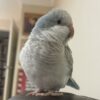
If you’ve been searching for a Quaker parrot that stands out from the usual green flock, the grey Quaker is one of the most striking, and least understood, color mutations in the breed. At Quaker Parrot online, we hand-feed and raise grey Quakers from hatch, and we currently have babies, juveniles, and fully weaned adults available, so you can choose the age that fits how you want to raise your bird.
Below, we’ll cover what actually makes a Quaker parrot “grey” (it’s not what most sites tell you), what to expect at each age, typical pricing, and importantly, whether it’s legal to own one where you live.
Grey Quaker Parrot at a Glance
| Trait | Detail |
| Species | Quaker parrot / Monk parakeet (Myiopsitta monachus) |
| Also known as | Quaker parakeet, Monk parrot |
| Color | Slate-grey (blue gene + dominant grey factor) |
| Size | 11–13 inches, including tail |
| Weight | 90–150 grams |
| Lifespan | 20–30 years with proper care |
| Talking ability | Excellent — among the clearest talkers of any small parrot |
| Noise level | Moderate — not among the loudest parrots, but has a sharp alarm call |
| Temperament | Social, playful, bonds closely with one owner or household |
| Good for beginners | Yes, with realistic expectations of daily interaction |
| Minimum cage size | At least 24″ x 24″ x 24″, bar spacing ½″–¾″ (bigger is better) |
| Diet | Formulated pellets, fresh vegetables and fruit, limited seed — a seed-heavy diet raises the risk of fatty liver disease |
| Native range | South America (Argentina, Bolivia, Brazil, Paraguay) |
The two questions buyers ask most are what “grey” really means, and which age is the right fit, so let’s take those one at a time.
What Makes a Grey Quaker Parrot Different
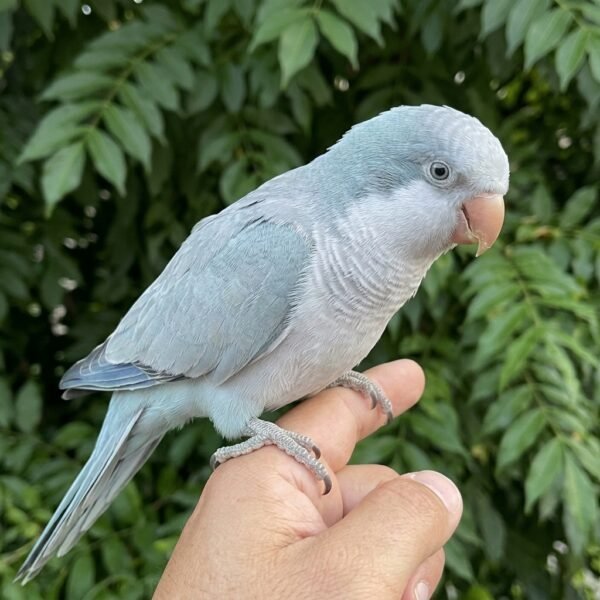
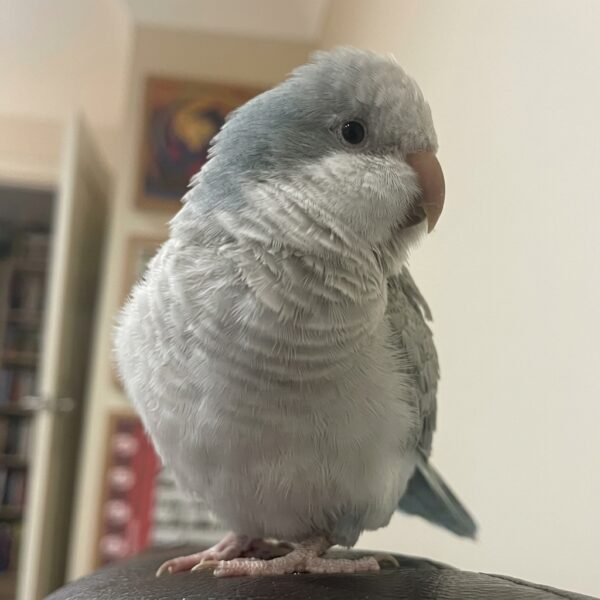
A true grey Quaker parrot isn’t simply a green bird with a grey face, it’s a distinct color mutation created by combining the blue gene with a separate dominant grey factor.
Here’s where most listings get it wrong: every normal green Quaker parrot already has a soft grey face, throat, and chest — that’s just its wild-type coloring, not the grey mutation.
A true grey Quaker carries two genes stacked together. The blue mutation strips out the yellow pigment that normally mixes with blue to make green, leaving a clean blue body. The dominant grey factor then mutes that blue into an even, soft slate-grey across the whole bird, rather than the brighter sky-blue of a standard blue Quaker. The tail and flight feathers often keep a faint cool-blue cast, which is one of the easiest ways to tell a true grey apart from a green bird’s grey face at a glance.
Because grey requires two specific genes coming together rather than just one, grey Quakers are harder to produce consistently than single-mutation birds like blue or cinnamon — part of why they carry a price premium (more on that below).
Quaker Parrot Color Chart
For context, here’s roughly where grey sits on the Quaker parrot color spectrum:
| Color | What It Is |
| Green (wild-type) | The natural, most common coloring — green body with a grey face and chest |
| Cinnamon | A diluted, warm brownish-green |
| Blue | Yellow pigment removed, leaving a clean sky-blue body |
| Grey | Blue + dominant grey factor — an even slate-grey body; one of the less common mutations |
| Cobalt | A deeper, darker blue-based mutation, sometimes confused with grey |
| Turquoise | A lighter, teal-toned blue variant |
| Lutino / Albino | Yellow or white — among the rarest and priciest mutations |
If a grey Quaker isn’t exactly what you had in mind, we also hand-raise green, blue, and cinnamon Quaker parakeets — just ask what’s currently available.
Choose an Age: Baby, Juvenile, or Adult
We keep grey Quaker parrots available at every life stage, because the right age depends on what you want from the owner-bird relationship.
Baby (Hand-Fed, Pre- or Just-Weaned)
The most hands-on option. Babies bond quickly to whoever feeds and handles them, which makes this the easiest age to shape into a well-socialized adult. Expect a short window of hand-feeding or fresh-weaning support from us before the bird goes home fully eating on its own.
Juvenile / Young (Weaned, Still Learning)
Fully weaned and eating independently, but still young enough to adapt quickly to a new home and new people. A good middle ground if you want a bird past the feeding-dependent stage that still forms strong bonds fast.
Adult (Hand-Raised, Established)
Already confident, and often already talking or stepping up reliably. A good fit if you’d rather skip the early training period, though adults can take a little longer to transfer their trust to a new owner than a baby would.
Every grey Quaker we sell, regardless of age, is hand-raised rather than parent-raised — the single biggest factor in how tame and talkative a Quaker parrot turns out to be.
Grey Quaker Parrot Price
Grey Quaker parrots typically cost more than standard green birds, since the color requires two combined mutations rather than one. Across U.S. breeders, rare mutations like grey and blue commonly range from the mid-hundreds up into four figures, shaped by:
- Age: babies and hand-fed juveniles are usually priced higher than older, already-weaned adults
- DNA sexing: a confirmed male or female typically costs more than an unsexed bird
- Talking / training: a bird that’s already talking or step-up trained often carries a premium
- Breeder practices: hand-fed, health-checked birds from a dedicated breeder cost more than mass pet-store stock, for good reason
Every grey Quaker parrot from Quaker Parrot online comes hand-fed, health-checked, and ready to ship or arrange for local pickup — see our shipping process below.
Is a Grey Quaker Parrot Legal in Your State?
Not everywhere — and this matters more with Quaker parrots than almost any other pet bird, so we’d rather tell you up front than have you find out after the fact.
Quaker parrots are restricted or banned outright in a number of U.S. states, largely over concerns about feral colonies affecting agriculture. Ownership is commonly prohibited or heavily restricted in states including California, Georgia, Hawaii, Pennsylvania (permit required), and Connecticut, among others, with some states requiring a permit, ID banding, or clipped wings instead of an outright ban.
State laws on exotic birds change and vary by source, so please confirm current rules with your own state’s Department of Agriculture or Fish & Wildlife agency before buying. We’re glad to help however we can, but we can’t ship a Quaker parrot into a state where it isn’t legal to own one.
Why Buy Your Grey Quaker Parrot Online from Quaker Parrot
- Hand-fed from hatch, every bird is raised on human hands, not parent-raised, for maximum tameness and bonding
- Health-checked before shipping, you’re not buying sight-unseen from a classified ad
- Every age available, baby, juvenile, and adult grey Quakers, so you choose the stage that fits you
- Safe, tracked shipping nationwide, live birds are shipped using carriers experienced in live-animal transport, with day-of tracking
- Real support after purchase, questions about diet, cage setup, or taming don’t stop at checkout
Ready to Bring Home a Grey Quaker Parrot?
Grey is one of the more distinctive colors in the Quaker parrot world, and we only have a limited number available at any time across each age group. Browse our current grey Quaker parrots for sale below, or reach out and we’ll help you pick the right age or match a bird to your household.
Frequently Asked Questions
How much does a grey Quaker parrot cost?
Grey Quakers typically cost more than standard green birds because the color requires two combined mutations. Price also shifts with age, DNA-confirmed sex, and whether the bird is already talking or step-up trained. See the pricing section above for the specific breakdown.
What makes a grey Quaker parrot different from a blue or green one?
A true grey Quaker carries both the blue mutation and a separate dominant grey factor, which mutes the blue into an even slate-grey body. This is different from the natural grey face and chest every green Quaker already has, and from cobalt, a darker blue-based mutation that’s sometimes mistaken for grey.
Are grey Quaker parrots rare?
Grey is less common than green or blue because it requires two specific genes to come together, rather than just one mutation. It’s not the rarest Quaker color — lutino and albino are rarer still — but it’s uncommon enough that availability is limited compared to standard green birds.
Do grey Quaker parrots talk?
Yes. Color has no effect on talking ability — it comes down to how the bird was raised. Hand-fed Quakers, grey included, are known for being some of the clearest talkers of any small parrot, often learning dozens of words.
How big do grey Quaker parrots get, and how long do they live?
Grey Quakers reach about 11–13 inches long and 90–150 grams, the same as any other color Quaker — color doesn’t affect size. With proper diet and care, they commonly live 20–30 years.
Is it legal to own a Quaker parrot in my state?
Not in every state. Quaker parrots are banned or restricted in a number of states, including California, Georgia, Hawaii, and others, due to invasive-species concerns. Rules vary and change, so confirm current regulations with your state wildlife agency before purchasing.
What age of grey Quaker parrot should I buy — baby, juvenile, or adult?
A hand-fed baby bonds fastest and is easiest to shape early on. A juvenile is fully weaned but still highly adaptable. An adult is already established and often already talking, which suits owners who’d rather skip early training. All three ages are available.
How do you ship a live grey Quaker parrot safely?
We ship live birds using carriers experienced in live-animal transport, with appropriate temperature handling and day-of tracking so you know exactly when your bird will arrive. Local pickup may also be available depending on your location.


Reviews
There are no reviews yet.